Beyond Labels: Supporting Dually Identified Multilingual Learners
Back to Blog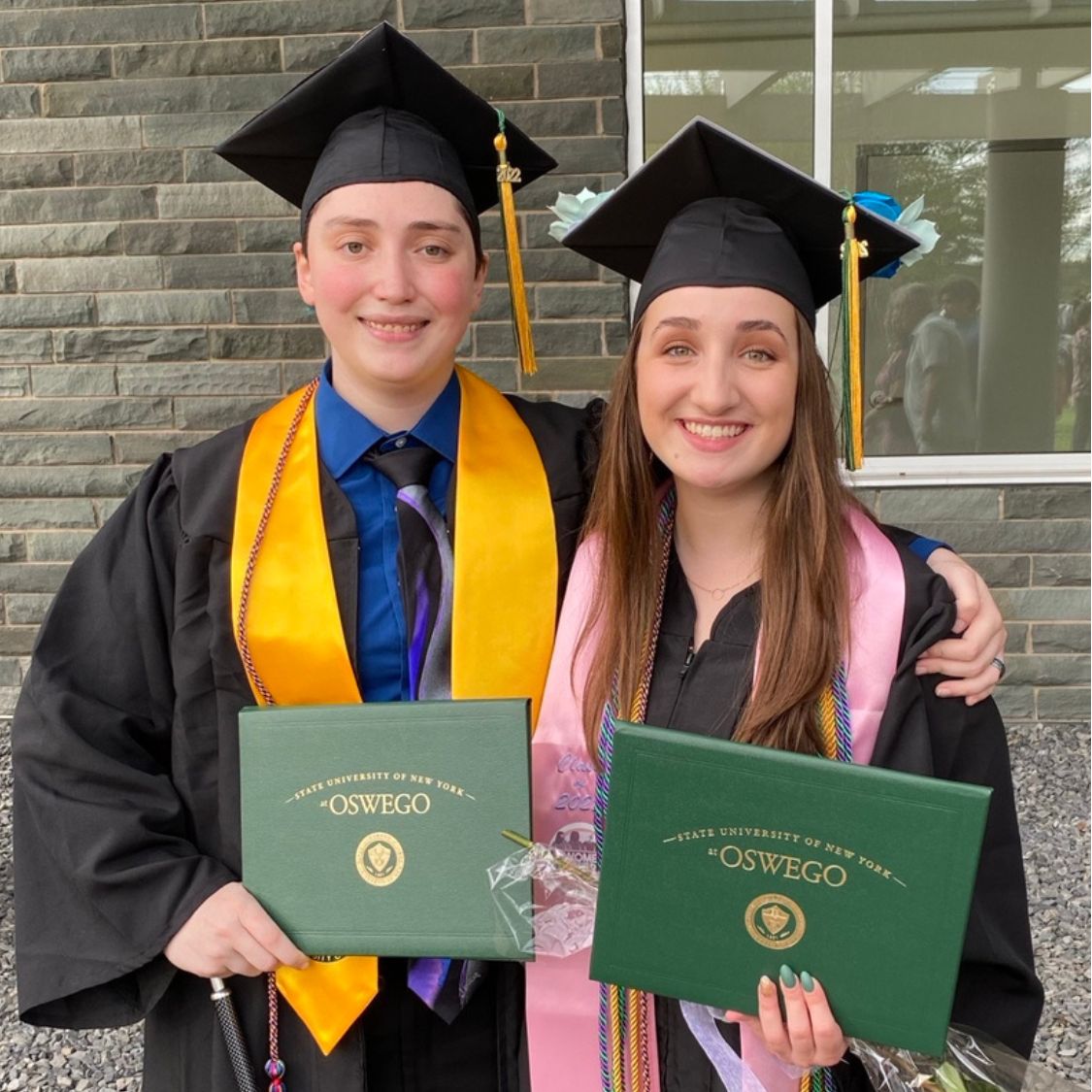
Caption: Gabriel Warner and Katie Miano at their graduation from SUNY Oswego in 2022.
In this interview between Mx. Gabriel Warner (they/he), ENL Teacher at Syracuse City School District and Ms. Katie Miano (she/her), ENL Teacher for Orleans/Niagara BOCES, two NYS TESOL members reflect on their professional journey four years after graduating from SUNY Oswego’s TESOL program. They share insights from their work with dually identified multilingual learners, discuss the unique challenges and rewards of supporting students with both language and learning needs, and highlight the importance of advocating for multilingual students and their families in Syracuse.
Thank you to our guest blogger, Katie Miano. We hope NYS TESOL members enjoy this thoughtful and inspiring conversation! We appreciate Katie Miano for sharing these wonderful insights with our larger community! It was lovely to see old friendships reunited through our Annual Conference--moments like these make our work meaningful!
With Appreciation, Katie Leven, Vice President of Communications
Katie Miano:
Welcome, and thank you for sitting down with me! For those who may not know, Gabriel and I graduated together from SUNY Oswego’s TESOL program in 2022. We coincidentally reconnected at the 2025 NYS TESOL Conference in Saratoga Springs, NY, and after hearing about Gabriel’s experiences and insights from the past few years in the classroom, I knew they would be the perfect person to interview.
To give our readers a bit of background, Gabriel joined the Syracuse City School District in 2022 as an ENL teacher shortly after graduating from SUNY Oswego. During their first year, they worked exclusively with dually identified English language learners in self-contained classrooms—a role that required a deep understanding of both language acquisition and specialized learning needs.
Since the 2023–24 school year, Gabriel has taken on additional leadership as the sixth-grade ENL teacher and the building’s ENL Content Liaison. In this role, they serve as an important bridge for the department while continuing to support English learners with disabilities in general education settings and providing intensive stand-alone ENL instruction. To further their impact in urban education, Gabriel is also a Syracuse University Urban Teacher Fellow and is currently pursuing an M.S. in Inclusive Special Education. So, Gabriel, reflecting on your time at SUNY Oswego, how did your experiences there shape your approach to teaching in Syracuse?
Gabriel Warner:
While completing my undergraduate degree at SUNY Oswego, all early childhood education students were required to take a childhood literacy course. I had a wonderful professor who was deeply committed to her students, though she didn’t have extensive experience with ENL or English language learners. What stood out to me was her approach when questions came up that she couldn’t immediately answer. Rather than dismissing them, she would do her own research and come back with thoughtful responses.
I really appreciated that commitment to continuous learning and inquiry, and it has stayed with me as I’ve moved into my own teaching career. Now that I’m an in-service teacher, I’ve seen how little exposure many content-area teachers have had to the realities of teaching English learners—even in a district with a large ELL population like Syracuse. Because of that, it’s incredibly important for ENL teachers to advocate for our students, as well as for professional development that helps bridge this knowledge gap for the other teachers in our schools.
Katie:
That dedication to continual learning clearly inspired your approach to advocacy in your own classrooms. What is the biggest misconception other educators have about dually identified multilingual learners, and how do you advocate against it?
Gabriel:
One of the biggest misconceptions is the belief that a student’s challenges come from only one source—either their language development or their disability. In reality, both can simultaneously impact a student’s performance and learning experience.
Sometimes, a teacher with experience teaching students with disabilities but not ELLs may feel unsure about how to teach English learners and attribute difficulties primarily to the student’s language proficiency. At the same time, a teacher more familiar with ELLs but not students with disabilities may attribute slower language acquisition primarily to a student’s disability. When this happens, the student’s needs aren’t being viewed through an intersectional lens.
For dually identified students, it’s important to remember that the process for identifying a disability is extensive and involves significant testing and evaluation. When done correctly, English learners are not overidentified as having a disability. If we trust that the process has been conducted appropriately, we must also recognize that both factors—the disability and the language development—can affect the student’s learning. Ignoring either one does a disservice to the student. Effective teaching requires acknowledging and supporting both.
Katie:
It’s such an important reminder that educators need to consider the full picture when supporting dually identified learners. How do you integrate your students' diverse cultural backgounds into the daily curriculum in meaningful ways?
Gabriel:
I work in a district where students come from a wide range of linguistic and cultural backgrounds. One of the key things I encourage teachers on my team to do is create space for students to share their own experiences whenever those opportunities arise.
Sometimes this requires translanguaging, particularly if a student is not yet fully proficient in English. Becoming more comfortable with translanguaging benefits all students because it allows them to access their full linguistic repertoire when expressing ideas and making connections.
These opportunities appear frequently in subjects like history, discussions of current events, or global topics, where students can contribute personal connections or background knowledge. Of course, meaningful connections can be made across all subject areas. When teachers intentionally create space for those contributions, students’ identities and experiences become an authentic part of the learning environment.
Katie:
Creating that space for students to share their experiences really seems key to making learning more meaningful. At the 2025 NYS TESOL Conference, was there a session or theme that resonate with your current goals in Syracuse?
Gabriel:
At the 2025 conference, I attended a session led by Jennifer Voorhees on supporting dually identified English learners and the importance of ongoing professional development. The session focused in part on English learners with significant cognitive disabilities, and it highlighted an issue that really resonated with me.
Often, for dually identified students, special education programming is prioritized over ENL programming. As a result, these students are more likely to receive their ENL services within special education settings rather than in more inclusive integrated environments. Voorhees also mentioned that ENL students are more likely to be placed in a more restrictive learning environment than a monolingual student with the same learning needs. Research shows that students in highly restrictive, self-contained classrooms often receive a lower quality of academic instruction and are exposed to less rigorous academic language overall.
This creates a kind of double loss for dually identified English learners. They may already be in a more restrictive special education environment, where they encounter less complex academic language, and then their ENL services take place in that same setting, limiting their exposure to the rich language instruction that might occur elsewhere. This makes it harder for them to develop the level of English proficiency required to both test out of ENL and be moved to less restrictive learning environments.
This topic resonated strongly with me because of the demographics in my own schools. More than 25% of our students are English learners or former English learners, and a similar percentage are students identified with disabilities. That means we have a significant number of dually identified students. After attending this session, I’m interested in bringing this information back to our ENL department so we can be careful and intentional about future placements and put processes in place to ensure these students have access to the highest quality instruction possible.
Katie:
That insight about restrictive placements really highlights the importance of considering both academic language and special education supports. Students’ communication devices are often English-only, even though their home life is multilingual. How can we better support multilingual Augmentative and Alternative Communication (AAC) systems? For those who are new to AAC systems, they are tools, strategies, and technologies used to support or replace spoken communication for individuals with severe speech or language impairments. AAC systems, sometimes called speech-generating devices (SGDs), assistive communication devices, or communication apps, enable users to express thoughts, needs, and ideas, improving communication and interaction.
Gabriel:
In education, we often talk about leveraging “funds of knowledge” and bringing community knowledge into the classroom. This is a perfect example of when that mindset is needed. There are adults who rely on AAC as their primary form of communication, and many of them are multilingual or former English learners. Their experiences are incredibly valuable.
We should be reaching out to those communities and learning from them—asking what systems worked for them, what challenges they faced, and what recommendations they have for students in similar situations today.
When I worked with my first fully nonverbal student—who was already in middle school and still did not have an AAC system—I sought out AAC communities online. I asked users which programs supported multiple languages, what tools they had successfully used across languages, and what the pros and cons were. I then brought that information back to the student’s IEP team, which included both their teachers and family members.
Ultimately, we need to value the knowledge and lived experiences of disabled adults if we want to better support our disabled students.
Katie:
Bringing in the expertise of adults who use AAC is such a powerful way to make systems more inclusive. Families are sometimes told that using two languages will “confuse” a child with a communication delay. How do you address this misconception?
Gabriel:
I believe there are two parts to effectively addressing this misconception: supporting both teachers and families.
On the school side, I make sure teachers understand what translanguaging is and how it can be used effectively in the classroom. When teachers recognize the value of students’ heritage languages, they are less likely to discourage students from using them and more likely to incorporate them as learning tools.
When working with families, I always ask about the languages spoken at home and whether the student uses their heritage language, English, or both. I strongly encourage families to continue speaking their home language with their child. When possible, I also suggest reading and writing together in that language.
This is especially important for students with disabilities, because families are sometimes told that multilingualism will confuse their child, or cause further learning delays. I reassure them that this is not the case. Developing literacy skills in a heritage language can actually strengthen English literacy because many skills transfer across languages.
Ultimately, I believe it’s our responsibility as educators to make sure families never feel that their child must give up their heritage language in order to succeed in English.
Katie:
That’s a crucial message—especially for students with disabilities, it emphasizes that multilingualism is a strength, not a barrier. Thank you so much for taking the time to chat with me! It was so wonderful reconnecting and engaging in such a fruitful conversation.
Gabriel:
Absolutely, it was a pleasure. Thank you!