Have you seen the VirtuaTELL Conference line up for this Saturday?
06/02/2026
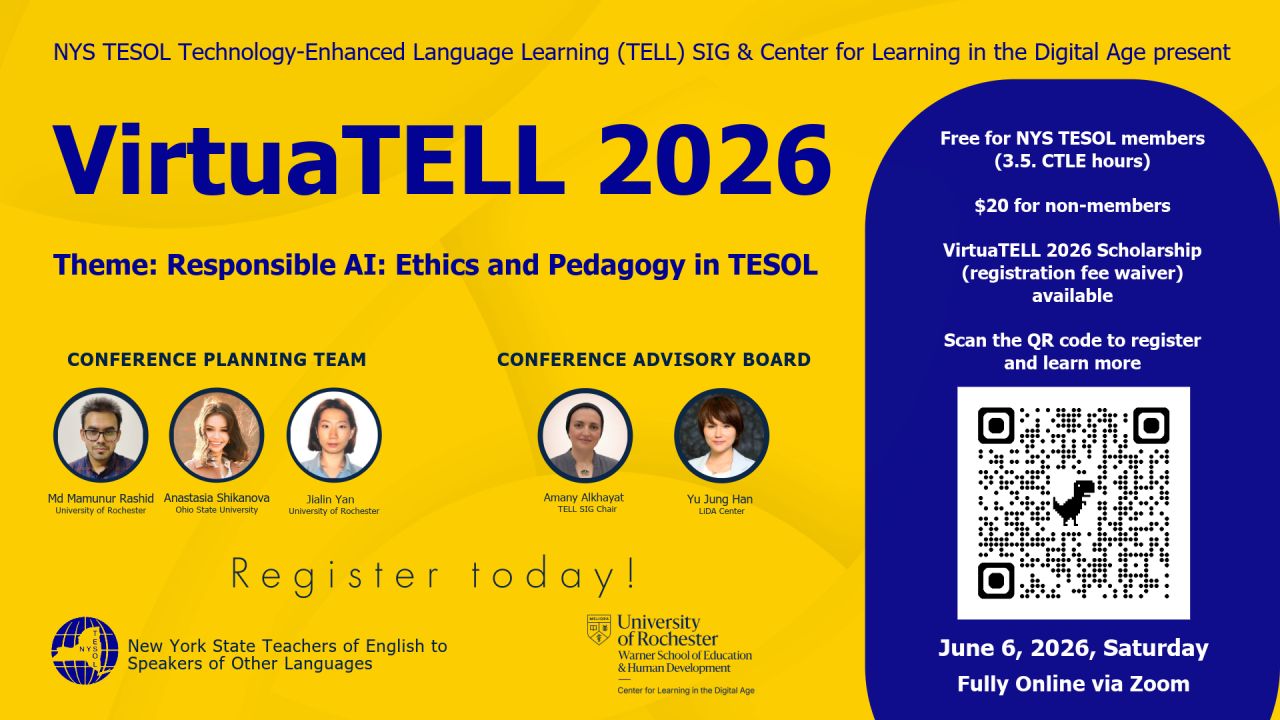
The NYS TESOL VirutaTELL conference, co-hosted with the Center for Learning in the Digital Age (LiDA) at the Warner School of Education, University of Rochester, distinguishes itself by moving beyond AI as a tool and examining AI as a pedagogical, ethical, and human-centered challenge for TESOL professionals. Through global perspectives, cutting-edge scholarship, and practical workshops, participants explore how educators can integrate generative AI while preserving agency, fostering critical thinking, and supporting multilingual learners in meaningful ways.
Theme: Responsible AI: Ethics and Pedagogy in TESOL
June 6, 2026 | Fully Online (Zoom) | 10:00 a.m. EST to 2:30 p.m. EST
Information here:
https://sites.google.com/nystesol.org/virtuatell2026/registration
Register here:
https://mms.nystesol.org/Calendar/moreinfo.php?org_id=NYST&eventid=220455
The 6th Annual VirtuaTeLL Conference is set to return on June 6, 2026, bringing together educators, researchers, graduate students, and thought-leaders from across the TESOL community for a dynamic day of virtual learning and collaboration.
This year’s theme, “Responsible AI: Ethics and Pedagogy in TESOL,” invites participants to explore one of the most pressing and exciting developments in education today: the integration of artificial intelligence in language teaching and learning.
As AI technologies rapidly transform classrooms and professional spaces, TESOL educators face important questions:
- How can AI tools enhance language instruction without compromising ethical standards?
- How do we ensure equity and access for multilingual learners?
- What does pedagogical integrity look like in an AI-supported classroom?
- How do we preserve the human connection at the heart of language teaching?
VirtuaTeLL 2026 will create a collaborative space to examine these questions. Through keynote insights, panel discussions, individual presentations, and hands-on workshops, attendees will engage with frameworks for responsible AI integration and envision a future where technology strengthens—rather than replaces—the human elements of TESOL.
Featured Keynote Speaker
We are honored to welcome Dr. Yu Jung Han as our keynote speaker. Dr. Han will share insights on ethical AI practices, innovation in language education, and the evolving role of educators in an AI-enhanced world.
Schedule
|
10:00-10:10
|
Opening Remarks and Keynote Introduction
|
|
10:10–10:55
|
Keynote Address
(45 mins)
|
Dr. Yu Jung Han
|
|
10:55–11:25
|
Plenary Panel (30 mins)
|
Dr. Amany Alkhayat
Dr. Asmaa Radwan
Dr. Ahmed Youssof
|
|
11:30–11:55
|
Session Block 1
Individual Presentations
|
BR #1: Dr. Syeda Farzana Sultana/ BRAC University
Agency, Ethics and Accountability in Integrating AI in TESOL Context: Perspectives from the Global South.
In this qualitative presentation, I explore the critical issues of ethics, agency and accountability and their pedagogic implications among the aspiring and experienced TESOL teachers in Bangladesh. The session highlights the questions of localization, ethicality and responsible use of AI, and proposes context-sensitive frameworks for responsible AI adoption in English language education.
|
|
BR #2: Dr. Nicole King / University of Rhode Island
Centering People in TESOL in the Time of GenAI
In 2026, it is possible that we live in an era of post-plagiarism (Eaton, 2021, 2023) and while it is essential to the ethics of teaching to develop our own generative AI literacy, we must never lose sight that we teach people – especially in a TESOL classroom.
|
|
BR #3: Wen Wen, SUNY Oneonta
Rethinking Literacy Pre-service Teachers’ Agency in AI-Supported Lesson Design: A Posthuman Synthesis of Three Empirical Studies in Teacher Education
This conceptual paper synthesizes three empirical studies to examine literacy pre-service teachers’ agency in AI-supported lesson design through a posthuman lens. Teachers’ agency emerges through interactions with GenAI and other human and non-human resources. Despite distributed agency, pre-service teachers must make informed professional judgments. Implications for teacher education are discussed.
|
|
11:55–12:25
|
Break (30 mins) – Coffee Chat / Networking
|
|
12:25 -12:50
|
Session Block 2
Individual Presentations
|
BR #1: Adma Gama-Krummel/University of Rochester
Rethinking AI Ethics in Higher Education: A Posthuman Perspective on Teaching-with-GenAI
This presentation examines how higher education research frames faculty engagement with GenAI and argues for a posthuman perspective that moves beyond adoption and efficiency toward questions of pedagogy, relationality, authorship, and educator subjectivity.
|
|
BR #2: Ahmed K. Yousof / East Stroudsburg University of Pennsylvania
Changing the Size of the Hill: Using AI to Deconstruct Overwhelm for Pre-service Teachers.
Psychology shows overwhelm occurs when the nervous system carries workloads alone. This session helps teacher educators equip pre-service teachers with AI strategies that alter the brain's perception of difficulty. Discover practical prompt blueprints that break through executive dysfunction, manage emotional fatigue, and create structured momentum loops to prevent student teacher burnout.
|
|
BR#3: Diana Murtaugh, Binghamton University
Grammar and AI: Evaluating AI Created Lesson Plans for MLLs in K-12 Education
I will review a project designed for preservice teachers in TESOL to evaluate and modify AI created grammar lessons. Students had to demonstrate their pedagogical learning by dissecting AI and defending their modifications.
|
|
12:55–1:25
|
Session Block 3 – Workshops
|
BR #1: Mark Jacobs, Clark University
Creating Custom AI Conversations to Reinforce Language Learning
AI is disrupting education, reducing traditional assessments’ effectiveness. This workshop focuses on redesigning assignments by creating AI-powered, dialogic assignments that reinforce language learning. Participants will learn how to create language learning experiences using custom prompts and Copilot Agents/Custom GPTs.
|
|
BR #2: Anastasia Shikanova, The Ohio State University
Responsible Prompting as Ethical Pedagogy: Teaching ESL Learners to Maintain Epistemic Agency When Using Generative AI
|
|
1:30–2:00
|
Session Block 4 – Workshops
|
BR #1: Mamunur, Warner School of Education, University of Rochester
Short Videos, Big Conversations: A Hands-On Workshop on Creating AI-Generated Micro-Scenes for Language Learning
In this hands-on workshop, participants will explore how generative AI tools can help create short video micro-scenes for language classes. The session will demonstrate how these videos can initiate speaking, writing, ice-breaking, role-play, and discussion activities that encourage meaningful classroom interaction."
|
|
BR #2: Yousra Ferchichi, AIA Doha
Your Career Compass: AI-Powered
Artificial Intelligence is transforming the way we learn, work, and navigate our careers. Yet, in a rapidly evolving digital landscape, human strengths such as self-awareness, adaptability, critical thinking, and purposeful decision-making remain essential for long-term success. This interactive presentation explores how coaching principles and responsible AI use can work together to support career development and professional growth. Participants will discover practical strategies for leveraging AI as a career companion while maintaining ethical standards, personal authenticity, and human-centered leadership. Through live demonstrations and real-world examples, attendees will learn how AI can be used to create a professional online presence through website development, support continuous growth through mobile self-coaching applications, and expand opportunities through Personal Learning Networks (PLNs) and professional community engagement. Participants will leave with actionable tools and resources to enhance productivity, strengthen career planning, build meaningful professional connections, and confidently navigate the future of work.
|
|
2:00–2:30
|
Closing Remarks + CTLE/Promotion from NYSTESOL + Thank yous Raffle
|
In short, what stands out most is that the conference is not about "using AI better"—it is about helping TESOL educators think critically about the relationship between AI, teaching, learning, ethics, and human connection.
We look forward to seeing you on Saturday!
More information can be found here:
https://sites.google.com/nystesol.org/virtuatell2026/registration
Register here:
https://mms.nystesol.org/Calendar/moreinfo.php?org_id=NYST&eventid=220455
- Free registration for NYS TESOL members (3.5 CTLE hours available)
- Non-members: $20 registration fee
- VirtuaTELL 2026 Scholarship (registration fee waiver) available
For scholarship information, please contact: techlearning@nystesol.org